J EDGAR


By Matt Neufeld

November 9, 2011

John Edgar Hoover, who came to be known as J. Edgar Hoover, firmly stands as one of the most bizarre, deranged, complex and dangerously corrupt politicians of the 20th century—right along his political dirty tricks foxhole companions Richard M. Nixon and Joe McCarthy.   A quick perusal of numerous articles and reports about the horrendous actions of the shameful Hoover in office backs up the scores of allegations that Hoover was indeed paranoid, power-mad, untruthful, obsessive about non-relevant matters, possibly racist, blind to changes in popular and political cultures, contradictory, hypocritical, possibly criminal in some of his actions, and definitely purely corrupt to the core.
 
That’s not exactly the list of career and personal characteristics, traits and skills that would quality a person to be the director of the U.S. Department of Justice’s Federal Bureau of Investigation, or FBI, for 37 years—which is, amazingly and shockingly, exactly what Hoover was, and for that long. Believe it or not—and Hoover’s actions would qualify for an entry in Mr. Ripley’s sideshow—Hoover was actually the FBI’s director from 1935 until he died in office in 1972. That stretches across an amazing eight presidents. At least eight of them should have fired Hoover on the spot, but Hoover’s crazily obsessive grip on his power caused him to amass secrets on many politicians—including presidents of the United States—and it was this method of using political secrets and playing them against everyone—almost purely to simply hold onto his corner of the political world at the Justice Department–that kept him in office for so long.  In many ways, Hoover’s desperate attempts to hold onto his power and run his FBI the way he wanted to run it—laws, rules, regulations, morals and ethics be damned—is just pathetic, and it is a sorry, sad and, in the end, depressing statement on the old absolute-power-corrupts-absolutely cliché. But with unstable people like Hoover, Nixon and McCarthy, the adage applies, and they stand as textbook cases regarding the very real dangers of absolute power and its destructive nature.
 
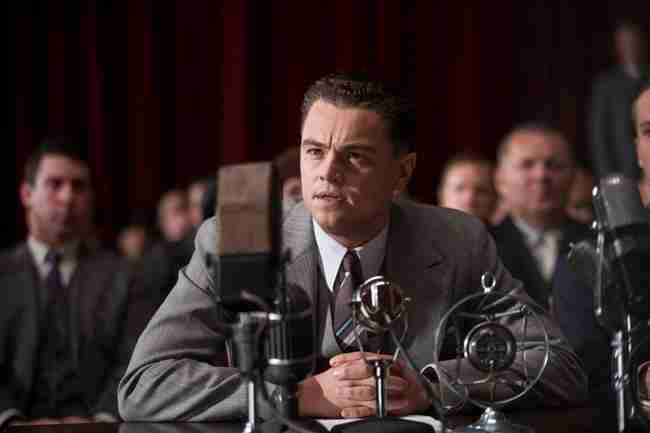
This issue of obsessive power  is played out against the equally corrupt and tarnished venues of politics, political careers, justice, ethics, law enforcement and the psychological complexities of personalities that fall into these various trappings in Clint Eastwood’s excellent, always-fascinating, intelligent and deeply compelling psychological, biographical and fact-based film character study of Hoover, “J. Edgar.”   This is a film that will likely stand as one of the better, more intelligent and well-acted films of the year, and it is a film that should be nominated for several major Academy Awards, including Best Actor for its star, Leonardo DiCaprio, who does indeed portray Hoover.
 
That’s right—Leonardo DiCaprio as J. Edgar Hoover. No, it’s not a stunt, a sham, a gamble or an experiment. It’s a wise move that pays off in big ways. Of course DiCaprio—one of the more youthful-looking 36-year-olds on the planet—doesn’t look anything like the older Hoover. But it’s amazing what Hollywood make-up artist Sian Grigg has done with her make-up artistry to make DiCaprio look like the older Hoover for most of the film.  The make-up artist succeeds in making DiCaprio look like the aging Hoover that you remember from real life. 
 
However, of course, it’s not just make-up that makes a performance resonate. DiCaprio delivers a bravura performance on every level to portray the older Hoover—where he does indeed look like the real-life Hoover—but also the younger Hoover, who was an energetic, brash, and, yes, power-climbing young buck eager to make a name for himself at the Justice Department. In his diction and elocution, in which DiCaprio had to copy Hoover’s fast, clipped, accented speeches and monologues, in his steely, cold-hearted, somewhat confused glances and smirks and sneers, and in his latter-day-Hoover body movements, in which the heavier, older Hoover moved a bit slower, DiCaprio easily captures the various, decades-sweeping changes of Hoover at various stages of his life. It’s a very real, very affecting, very complex portrait of a very real, affecting and complex man.  DiCaprio should certainly be nominated for Best Actor—and it’d be a great win if he won it; he’s that good in this film.   
 
“J. Edgar” strives to tell a decades-spanning period story of the rise of John Edgar Hoover from that brash young Justice Department agent to troubled FBI director, starting in the early days of Hoover’s career in the 1920s, as the FBI was literally being formed, and as a growing country was dealing with growing sciences—early forensics, fingerprinting and careful, detailed examinations of crime scenes—and growing crime.  Some historians have given Hoover some positive credit for focusing on early forensics and fingerprinting, in the developing stages of his career, as actual innovative and influential events in law enforcement.  Those early developments did indeed occur, and they are depicted in the film.  During the mid-twentieth century, he country was also dealing with rising and troubling crime problems—rogue gangsters and bank robbers, brash celebrity kidnappings such as the famed Lindbergh baby case, the rise of organized crime, political corruption associated with gangsters, the perceived but largely unwarranted worries about Communism, spies, underground radical groups, the rise of the Mafia, and the rise of organized opposition groups that targeted the so-called “establishment.” 
 
That’s a lot of problems for the director of the FBI.  And depicting the scope and background of some of these events could be a lot of problems for lesser filmmakers.  But It’s a huge credit to the filmmakers of “J. Edgar,” and Eastwood in particular, that they were ambitious enough to present not only the story of Hoover, but the story of Hoover set against these myriad historical events. You have the aforementioned crime problems depicted in various segments, shown in historically-accurate scenes that evoke specific times, places and people, down to every achingly-researched period detail. There’s appearances in the story by Charles Lindbergh, by the intermediary in the kidnapping case John Condon, by the accused kidnapper Bruno Hauptmann, and by Bobby Kennedy, Richard Nixon, Dwight Eisenhower, Shirley Temple, and myriad other historical figures. There’s depictions of parts of the Lindbergh kidnapping investigation, the gangster arrests, the investigations into radicals, the formation of early forensics laboratories, the secret investigations of alleged Communists, the spying on political figures, the spying on JFK and Martin Luther King, the continuing development of the FBI, and even period-detailed depictions of presidential inaugural parades through Washington.
 
And towering over and against and inside all of these events is the ever-present Hoover.  DiCaprio shows us the young Hoover as relentless in his march up the Justice and FBI political position ladders, doing whatever he can to create what would become his little empire. But as the film and the story progresses, slowly and surely, obviously and not so obviously, the deeper and darker and dangerous elements of Hoover’s persona and personality start to emerge. And, seamlessly, the early historical film transfers to that complex psychological character study, as Hoover starts to stray from normalcy and rationality.  As he ages and consolidates his grip on the FBI and as he fights to keep his precious power, Hoover starts to just unravel. And much like his equally-excellent portrayal of the equally-complex Howard Hughes in Martin Scorcese’s “The Aviator,” DiCaprio doesn’t let his portrayal dissolve into farce and parody. Rather, he shows the dark sides of the complex Hoover in a human light—Hoover is presented as a human being, with conflicting emotions and feelings that, again, keep the proceedings from becoming a hit job or some type of dark comedy.
 
The film handles all of the controversies about Hoover—and there was a lot of controversy—in a very even-handed manner, letting the story unfold without sensationalism, insults, digging or offensive partisanship. It’s a careful, steady psychological character study of, again, an unusually, bizarrely and scarily complex historical and political person.  The film presents Hoover and the other main characters as complex human beings, and the film doesn’t really judge too harshly—a credit to the film is how director Eastwood and screenwriter Dustin Lance Black (“Milk”) let the story unfold in a natural, straightforward, historical manner—with all events based on actual, real-life events (it’s not “JFK”ish at all). 
 
The filmmakers let the viewer decide just what to make of these very strange, complex and confused people.  However, at the same time, the film also does not gloss over the facts that Hoover, as the director of the FBI, was contradictory and hypocritical and corrupt—he often broke the very laws that his agency was supposed to uphold.  Also at the same time, the film also notes, accurately, that Hoover was also psychotic, and that Nixonian psychotic, paranoid nature negatively affected his judgement throughout his life.  It’s that moral and psychological complexity—a portrait of a law enforcement figure heading a law enforcement agency while also being corrupt, paranoid, psychotic and morally bankrupt—that makes the film fascinating and compelling.
 
Okay, you’ve been waiting eleven paragraphs for mention of one of the more strangely interesting aspects of Hoover’s life—his mysterious relationship with his best friend, best political ally and closest comrade at the FBI, Clyde Tolson, excellently portrayed in the film in an equally complex manner by the young actor Armie Hammer (“The Social Network”).  There are those who maintain, some of them publicly, that Hoover and Tolson were gay lovers, and secretly attended gay parties, and there are those who maintain that they were not.gay. Yes, understandably, the first rational reaction anyone with a heart would have is, “Who cares, why does this matter, and it’s none of our business.” Well, there’s an addendum to that reaction.  Sometimes, when powerful political leaders act a certain way and do certain things in political office that strongly and directly contradict what they’re doing in their own personal life, it very well could matter. The one defense that people raise regarding the importance of Hoover’s private sexual life is that as a powerful politician in a powerful law enforcement position, he conducted illicit and questionable investigations into the private sexual lives of numerous people—including First Lady Eleanor Roosevelt, President of the United States John F. Kennedy, and peace activist and Nobel Prize winner Martin Luther King. So one argument goes—if you’re a powerful politician and law enforcement official conducting questionable and illicit investigations into the sex lives of these powerful people, then perhaps what you did in your private life did indeed matter. It’s the same argument leveled against conservative politicians who state publicly that they are against gay rights, gay education, gay marriage and even gay relationships—yet, ultimately, these same folks are caught literally with their pants down with same-sex partners in houses on Capitol Hill, online, at parties, and in the men’s room at airports.  It’s the hypocrisy and contradictions relating to the political aspects of the issue that people cite as a reason for the relevance of the actions of politicians in these matters. 
 
The film, again, to its credit, presents the Hoover-Tolson relationship in that same careful, steadied, respectful and mannered way—not sensational, not gratuitous, not offensive, and always with the view that, aside from the politics, these are simply two men who genuinely cared for each other.  Clint Eastwood himself summed it up nicely in a recent interview with The New York Times:  “Obviously, there’s a love story here. Whether it is a gay love story or something else—well, the audience can interpret it. My intention was to show two men who really love each other, and beyond that it’s none of my business.”

It’s that attention to human detail that permeates “J. Edgar.” Additionally, accolades should be sent to the production design team, for painstakingly depicting elaborate period details—hair styles, clothes, cars, furniture, props—in various settings, from the 1920s on up to the early 1970s. And if you look closely, you can see the attention to period details in all of these areas.  Additionally, Black’s screenplay should be noted for his attention to historical detail, the scope of the story, and the difficulty in presenting such psychologically complex characters.  Naomi Watts as Hoover’s fiercely loyal secretary Helen Gandy and Judi Dench as Hoover’s domineering but caring mother round out the principal cast.

The film was produced by Eastwood, Brian Grazer (“A Beautiful Mind,” “Frost/Nixon”) and Robert Lorenz, who worked with Eastwood on the Eastwood-directed “Letters from Iwo Jima” and “Mystic River.” Interestingly, in a real-life twist that’s not portrayed in the film, one of Hoover’s long-running associates at the FBI, W. Mark Felt, succeeded Clyde Tolson as the FBI’s Associate Director in the wake of Hoover’s death in 1972.   Felt, in a nice twist that would make a great story for another film, turned out to be the “Deep Throat” source for information on the Watergate scandal for Washington Post reporters Bob Woodward and Carl Bernstein.  That valuable information from Felt—valuable FBI secrets–helped lead to the subsequent resignation of President Richard Nixon. 

J. Edgar (137 minutes, at area theaters) is Rated R for brief strong language.

Matt Neufeld is a longtime journalist, actor and film critic in the Washington and Baltimore areas. He has participated in many local film events and projects in the region, and he has appeared as an actor, supporting actor and extra in more than 45 films projects, at all levels, during the past 20 years. He was previously a daily local news reporter and features writer for The Washington Times and The Frederick News-Post, and he was the media relations publicist for The Washington Performing Arts Society. Matt is currently the News Editor for Carroll Publishing in Bethesda.